The wrestling angel gifted Jacob with a limp as a permanent reminder of his encounter with God. Jacob's life-long policy was to run. His final glory was that he learned to lean (Hebrews 11:21). A wound is a good thing if it is accepted as a stewardship from God, appropriated as a channel of God's strength and consecrated to God's purpose. Where dependence is the objective weakness is the advantage.

Tuesday, December 25, 2012

What the Shepherds Heard/What the Shepherds Saw


And the shepherds returned, glorifying and praising God for all the things they had heard and seen, as it was told unto them.
                                              Luke 2:20

Faith is belief before sight. Faith is conviction about what God says before confirmation through what God shows. Our faith is tested, tried in fire. Peter writes that believers are priests and we know that God will purify the sons of Levi. He refines us like gold is refined. We each have our seasons of burning.
The testing necessarily includes some kind of disappointment. We hope things will go one way, we pray accordingly but the thing we didn't want prevails. The great thing is to be sure the disappointment is not degraded to the point of doubt or even despair, to the place where faith begins to break upon the rocks.
If nothing we ever learned from God's Word ever appeared to be true in our experience few of us would have remained Christians very long. But what God says about the world, about history, about the way people are as they abide in their respective spheres of belief and unbelief, is more than enough to shelter faith when the test comes. That and the overwhelming sense that, like the Hebrew children in Babylon, we are not alone in the furnace.
The elapsed time between what the Shepherds heard and what the Shepherds saw was short. The time was made even shorter because they made haste and searched out God's promises without delay. Not a bad model for ourselves.
We are not likely to be favored with a vision of angels. The privilege of the Shepherds was enormous. They worked in the right neighborhood at the right time. But they doubtless knew their trials in after-years. Perhaps trials which even made them doubt the reality or the relevance of what they saw that night.
But it WAS real. 
And it remains eternally relevant.
The elapsed time in our own case will be longer for sure. But our prospect is just as sure.
Like them, we shall behold Him.
No longer lying in a manger but seated upon a throne.
The shepherds will be there too.
Still glorifying and praising God.
Merry Christmas from Memphis

Thursday, November 29, 2012

A Preface to Paradise Lost: Remembering CSL on His Birthday


Today is the birthday of CS Lewis, the most quoted Christian author of the 20th Century. This blog has been virtually retired for the better part of a year while I was applying for residence in a country unfriendly to the faith. The lower my profile, I reasoned, the better my chances. Now that my application has been turned down there's no reason not to pay tribute to my favorite writer.
Many pass through a Lewis phase and grow out of it. I never graduated, and my awe of the man increases with each passing year.
I don't discount Lewis' failings. He never tired of reminding his readers that he was an untrained layman and no authority on doctrine. We heartily agree. Sometimes his mishandling of doctrine can only elicit groans. In "The World's Last Night" (otherwise a wonderful essay) he concluded that the limitations of the Incarnation (explained by Jesus' own declaration that " concerning the day and hour no one knows...not even the Son" ) led Him to a mistaken  prediction of a 'this generation" Return. That of course is awful.
But where Lewis is good he is splendid. If the proof of an apologist's worth is conversion then Lewis is the probable leader in market share. Better than anyone he shows with clarity and power not only that Christianity is true but that it is right and good that Christianity should be true.
The choice may surprise but I'm not sure that “A Preface to Paradise Lost " does not showcase Lewis' peculiar genius as much as any other effort. Though a work of Literary Criticism, Lewis was able to smuggle in a considerable quantity of Christian Apologetics since Milton wrote on a biblical theme. Lewis wrote all his non-fiction in the first person.
He turns that policy to advantage when he slips in a testimony which approaches the border of personal witness.
"...I should warn the reader that I myself am a Christian and that some of the things which the atheist reader must 'try to feel as if he believed '... I do believe. But for the student of Milton my Christianity is an advantage. What would you not give to have a real, live Epicurean at your elbow while reading Lucretius?" (Chapter 9)
One of Lewis' great assets is his ability to diagnose some misfortune on the modern scene we already sensed but never understood. We could not understand because, like Dr. Watson, we looked but we did not observe. Had we understood we may not have been able to express. Our powers of articulation would have failed us. The marriage of acute observation and memorable classification is a happy commonplace in the Lewis canon.
"The modern habit of doing ceremonial things unceremoniously is no proof of humility: rather it proves the offender's inability to forget himself in the rite, and his readiness to spoil for everyone else the proper pleasure of ritual." (Chapter 3)
or ,again, on the same subject
"(Ritual) renders pleasures less fugitive and griefs more endurable, (it) hands over to the power of wise custom the task of being festive or sober, gay or reverent, when we choose to be and not to the bidding of chance." (Chapter 4)
What Lewis says about Milton we can say about himself:
"The whole art consists not in evoking the unexpected, but in evoking with a perfection and accuracy beyond expectation the very image that has haunted us all our lives." (Chapter 8)
In all his books he displayed the capacity to illumine his subject by citing correspondences from disparate spheres. In 'Mere Christianity' he famously compares regeneration to toy soldiers coming to life.
The folly of Satan's unwitting self-destruction by rebellion is thus related:
"  "It is like the scent of a flower trying to destroy the flower." (Chapter 13)
Lewis' stock in trade was the startling spiritual insight-
" ...the only point of forbidding it (the fruit on the tree) was to instill obedience." (Chapter 10)
He offered convincing historical summaries-
" The older Puritans took away the maypoles and the mince pies: but they did not bring in the millennium, they only brought in the Restoration." (Chapter 19)
He persuaded by analogies unexpected but exceedingly apt. His language, in the words of JAW Bennett his successor in the Cambridge chair, would "always elucidate, never decorate."
He was born 114 years ago. His departure is now nearly 50 years past.
No one with a remote claim to be his equal has graced our horizon since.

Saturday, January 28, 2012

Confession


Robert Murray M’Cheyne (1813-1843)

Daily I try to follow the Bible readings of Robert Murray M'Cheyne. M'Cheyne, who entered Heaven before his 30th birthday, is reputed to have been Scotland's greatest preacher. Today I am at Matthew 28-The Resurrection and The Great Commission. Matthew 28:19 is called The Great Commission. The Saviour enjoins those who are His to go and tell. The next (and last) verse of the First Gospel is a kind of Great Comfort. We are promised that when we go He will accompany. The first recorded words of Jesus (Luke 2:49) are an explanation of why He was not with His parents. Jesus' last words in the Gospels are a promise that He will be with His disciples. More specifically the promise is made to disciples who carry out His orders.
And joyful orders they are.
Three days ago a friend told me "My enthusiasm about living the Christian life is exactly proportional to my willingness to share my faith." CT Studd, who enjoyed celebrity at Cambridge in the 1890's, died in the Belgian Congo in 1931. He confessed that when he stopped sharing his faith as a way of life his love for Jesus grew cold.
My assignment in the Church where I worship affords me the title 'Pastor'.
Because the church I serve is in Hungary I am sometimes called a 'Missionary'.
Because I am called both Pastor and Missionary it is a reasonable assumption that my life is adorned by much prayer and constant witness.
That assumption is false.

Saturday, December 31, 2011

Elizabeth II Rocks


26 December

After reading what I thought was an unedited version of the Queen’s annual Christmas address to the nation yesterday I wrote to some friends that the Queen, though never actually mentioning the name "Jesus", actually called Him a Saviour sent into the world by God. Naturally I was delighted by that.

Today when I listened to a BBC Replay of the entire address I was much more encouraged. What I originally wrote was inaccurate, because the version I read had excised the Queen's strongest Christian remarks. No great surprise there.

That gracious lady did indeed refer to JESUS.

“Jesus was born into a world full of fear. The angels came to frightened shepherds… ‘Fear not,’ they urged, ‘we bring you tidings of great joy which will be to all people. For unto you is born this day in the City of David a Saviour who is Christ the Lord.’

Although we are capable of great acts of kindness history teaches us that we sometimes need saving from ourselves—from our recklessness or our greed.”

The Queen was not crafting a theological treatise. If she were, we would have hoped she would have gone farther. We would have hoped she would say, “All of history, all our experience, our conscience and Holy Scripture make it overwhelmingly obvious that we do indeed need saving from ourselves ALL THE TIME. We need saving not only from our recklessness and greed but also from our unbelief.”

But I’m grateful for her boldness in going as far as she did. Her words were wisely chosen especially when we consider who her audience is. This Queen has been a consistently underrated superstar. Throughout the address she emphasized our desperate need of forgiveness and love. She is the titular head of the Church of England. She is the reigning monarch over a Kingdom where there are more Muslims at the Mosque on Friday than there are Anglicans at Church on Sunday. It would be too much to hope that the themes of love and forgiveness have been prominent in those Friday meetings in recent years.

The Queen went on:

“God sent into the world a unique Person—not a philosopher nor a general (important as they are), but a Saviour with the power to forgive. Forgiveness lies at the heart of the Christian faith. It can heal broken families. It can restore friendships. And it can reconcile divided communities. It is in forgiveness that we learn the power of God’s love.

In the last verse of this beautiful carol ‘O Little Town of Bethlehem’ there is a prayer:

O Holy Child of Bethlehem
Descend to us we pray
Cast out our sin
And enter in
Be born in us today

It is my prayer that on this Christmas Day we might all find room in our lives for the message of the angels and for the love of God through Christ our Lord.”

Preach it Sister.

God save the Queen, say I.

But I’m pretty sure He already has.

Friday, December 16, 2011

The Death of Christopher Hitchens


(1949-2011)


The Death of Christopher Hitchens

Last night Christopher Hitchens discovered he had an immortal soul after all. As far as his present state of consciousness goes I'll leave it at that. His mortal frame expired at MD Anderson Hospital in Houston. He was 62.
He was a prolific journalist and literary critic, but he was most famous as a leading exponent of The New Atheism. Along with Daniel Dennett, Sam Harris, and Richard Dawkins he was included in the group known as The Four Horsemen, an elite coterie of particularly vocal and virulent atheists whom he confessed himself honored to be among. The New Atheists are distinguished from the old atheists mainly by an insistence that there is no reason to be respectful of religion in general or Christianity in particular. On the contrary, duty demanded that a thing as evil as belief in God be combated tirelessly. AJ Ayer, a pioneering hero of the new school, declared that Christianity was not only a bad religion, it was the worst religion. No person of faith was off limits and no cow so sacred as to be spared. He famously referred to Mother Teresa as The Ghoul of Calcutta and called her a "lying, thieving Albanian dwarf."
Positively I can say this about him. He was an adroit debater- far cleverer than Richard Dawkins. Dawkins knows nothing of history or philosophy-precious little about anything outside his specialty.
Hitchens came off like a polymath.
He wasn't.
He scraped by at Balliol College Oxford with a Third. He mocked CS Lewis' famous trilemma as "pathetic". (The 'Trilemma' was actually originated by an earlier Oxford scholar-Alfred Edersheim, a Viennese Jew converted in Budapest in the 1840's. The idea is as follows: When we look at the breathtaking scope of Jesus' claims we are not left with the option that He could have been a great teacher merely. Great teachers don't claim the authority to forgive sins. In fact Jesus assumed prerogatives of Deity. Jesus, according to Edersheim, Lewis and a host of others, leaves us with but three options. Either He knew He wasn't God, though He claimed to be, which would make Him a liar. Or He thought He was God but wasn't, which would make Him a lunatic. Or...His claims were true. Hence the Trilemma: Lord, lunatic or liar.)
It is particularly laughable that Hitchens would mock CS Lewis as a shabby thinker as Lewis was awarded three Firsts in one undergraduate career at Oxford, countering Hitchens' lowest with his highest.
But Christopher Hitchens' projection of a broad, urbane intellectualism was dazzling. There's little doubt that after University he began to do his homework. And he was indefatigable. Possessed of a roguish charm he could be self-deprecating, and it was seductive.
But...
Charm is deceitful.
The coherence of his arguments was apparent not real. Like all atheist debaters he lingered not long over:
1) The inexplicable existence of matter and energy
2) The bridge from the material to the sentient
and
3) The powerful valence of morality as an intellectual and emotional force.
He steered clear because atheism (recent attempts of Stephen Hawking notwithstanding) cannot plausibly account for these realities. He preferred to rant along the lines of the hypocrisy of professing believers (a primary emphasis of the Gospels), the scandal that God would allow suffering (one theme of the Book of Job) and the alleged unfairness of hell -a charge his own stated preferences undermined.
He was an inveterate blasphemer.
Ironically, (and this would not have pleased him), he confirmed two of CSL's theories about unbelief. If God does not exist why the emotive focus? Lewis remembered that while he was an atheist he was absolutely sure that God was not there. He was also very angry with this God who-is-not-there kind of God. Christopher Hitchens hated the Christian God for the stupefying reason that he felt morally superior to Him. When you listen to his arguments Richard Dawkins is actually begging us not to believe in God simply because he himself cannot conceptualize such a being. It never seems to have occurred to Dawkins that God may not be a carbon based life form after all. The thrusts of Hitchens' own atheism moved along different lines. Hitchens’ consistent plea was that if God exists He is morally contemptible.
At least he served the noble purpose of proving that hypocrisy is not the exclusive domain of religion. Hitchens deserted his wife and two year old while his wife was pregnant. He deserted them for a woman he moved in with the day he met her. He blamed the God who wasn't there for all suffering (presumably also the suffering of his wife and children) but worshiped Leo Trotsky, a blood-curdling mass murderer. That’s not all, but the man is dead and there's no need to pile on.
Hitchens also confirmed Lewis' contention that it is a mistake to assume all unbelievers prefer heaven to hell. Hitchens said that heaven would be like living in North Korea. As he believed the Christian God to be at least as vile as Kim Jong-il he viewed the Christian heaven as a place so loathsome he wouldn't want to be caught dead there.
Therefore he met at least one of his goals by dying.
I had prayed for him as recently as two days ago.
Sic transit gloria mundi.

Sunday, June 19, 2011

Spurgeon


June 19, 1834 – January 31, 1892

Today is the birthday of Charles Haddon Spurgeon, the greatest preacher ever to preach in the English language. I'd be happy for disagreements, because other candidates could inspire a nomination for second place. Whitefield? Martyn Lloyd-Jones? John Stott? I really have no idea who should be second.
But I suspect it's a distance second.
Spurgeon was the son and grandson of ministers but was not converted without difficulty. The precipitating event was a snow-storm while the 15 year-old was trying to walk to a ferry on a Sunday morning early in the year 1850. Realizing the inadvisability of pressing against the weather he took shelter in a Primitive Methodist Chapel at Colchester. Conditions were such that the preacher never arrived at the service, so the sexton preached extemporaneously from Isaiah 45:22: "Look to Me. all ye ends of the earth and be saved."
Spurgeon did and he was.
The sexton's name is lost to history.
Within five years hardly a building in England could house the crowds who wanted to hear the boy preacher.
He began as pastor of a small chapel in Waterbeach, Cambridgeshire. He left there for New Park Street Chapel, London. Soon the facilities were inadequate to contain the throngs, and so, in time, the great Metropolitan Tabernacle was built.
What was the secret of his greatness?
God, God and God.
Apart from that obvious answer four things stand out.
!) Spurgeon had an unshakeable conviction that the Bible is the Word of God. He ministered in an era when confidence in biblical authority was in dramatic decline. The emergence of evolution meant that human life was being accounted for naturalistically. Liberal criticism contended that Holy Scripture could be accounted for humanly. The day of confidence in the divine source of anything seemed to be passing. Spurgeon never blinked. His sermons were powerful because they reposed on the infallible authority of a speaking God.
2) Spurgeon was a lover of the Lord Jesus Christ. He adored the immaculate Person of the bleeding Savior. He worshipped as he preached and showed the worship of Jesus to be a beautiful and necessary thing from which no sane creature should shrink.
3) He believed in the absolute sovereignty of God when it came to saving sinners. Possessed with gifts of evangelistic persuasion unparalleled in the world he nevertheless insisted, "I could as easily create a planet as I could save a soul. Salvation is God’s work."
4) He embraced the sphere of human instrumentality with ardor. He believed that the sovereign God sovereignly determined to use the pleading of fallen creatures to bring their fellows to repentance. And so he pled. Solemnly but winsomely, logically yet not without emotion, and lovingly yet without compromise he pled.
Under God's good hand he preached up a harvest
And under God's hand he reaped abundantly.
Of course his sermons were not solely evangelistic. His sermons fed the church, grew disciples and raised up missionaries.
Nor was he solely a pulpit warrior. He founded an Orphanage and a Pastor's College. He supported the widows of pastors. He provided cheap books for ministers and he sent out home and foreign workers.
He took no salary but lived off the sale of his sermons and books.
We now languish in a second century since Spurgeon.
May God grant another.

Friday, June 17, 2011

Sometimes Mid Scenes of Deepest Gloom...


A voice was heard in Ramah,
Weeping and great mourning,
Rachel weeping for her children,
And she refused to be comforted
Because they were no more

Weeks ago I wrote something about the death of Osama bin-Laden but I didn't post it.
I've made a few visits to countries where his ideology holds sway. I'd like to do a bit more in such places before I'm done.
Therefore my ambition inhibits my candor.
But this week there was another death which I simply must write about.
Years ago I was reading one of Ruth Bell Graham's Memoirs.
She was remembering her father's missionary colleagues in China, and in one section she enumerated their monumental suffering.
There's a strange notion about that if we try to make righteous choices and consecrate our lives to high purposes we will somehow escape any disturbance to the comfort of our lives.
Any survey of the brief Life and painful Death of Jesus of Nazareth ought to be sufficient to disabuse us of that illusion.
But the myth persists. I suppose it is a species of the equally mythological belief that we can merit or earn our own salvation.
For years I've known a young Dutch couple who are sterling Missionaries. He left a brilliant career in Physics, they moved to Budapest, bore down, and learned the language in record time. He wrote a book in Hungarian while still in his 20's. They'd been told they could not have children. A few months ago she conceived, but early on the doctors warned them with dark forebodings. This week they were presented with their little Rebekah. And a few hours later the child entered heaven.
Yesterday I had a brief visit with them in the hospital.
I suppose it's something God knew He could trust them with-this assignment no Christian would want. This assignment so like the assignment God the Father took upon Himself.
God will not prove His love for us by keeping those we love from suffering and death.
He offers that proof in a different way.
He proves His love by refusing to protect the One He loves from suffering and death.
They know that and they brought it up.
Like Jesus they have suffered.
Like Jesus they will die.
Like Jesus they will rise.
And they will prevail.

And when my task on earth is done
When by Thy grace the victory won
E'en death's cold wave I will not flee
Since God through Jordan leadeth me

Friday, April 22, 2011

The Last Gift


A jar full of sour wine was standing there; so they put a sponge full of the sour wine upon a branch of hyssop and brought it to His mouth. And when Jesus therefore had received the sour wine, He said, "It is finished." And he bowed His head and gave up His Spirit."
John 19:29-30

It was at the Wedding Feast in Cana of Galilee where the Lord Jesus offered His first gift to the Church. The guests at the reception were the first physical beneficiaries of that miraculous wine. But surely you and I and all believers are beneficiaries as well. The wine was judged to be exceptionally good, a wine which everyone was pleased to drink.
Today, Good Friday, we naturally think of the Feast which was not festive. It was Passover Week during the long ago Spring when the Jewish Messiah was slain upon the Roman Cross. The irony is as obvious as it is cruel. Passover marked the occasion when God spared the sons of Israel in Egypt. That Spring they celebrated by taking the Life of the Son of God in Jerusalem.
Both Feasts culminated in a gift of wine.
The wine offered to Christ was of a far different quality than the wine offered by Christ.
Apart from death itself it was our last gift to Him.
Only He could give the wine no one was able to make.
Only He would drink the wine no one was willing to take.
Christians take pains to combat sin. It is well that we should. We may begin a fast, study a book, or join a group. Anything that helps me not to sin is a good thing. And I need lots of help.
I find that Good Friday helps.
And I am helped specifically by that gift of sour wine.
When I am tempted: the lustful gaze, the unkind word, the selfish choice...in those rare victorious moments I check myself and ask,"Is this the gift I offer Him, Who gave such gifts to me? Do I offer Him the dregs, the vinegar of my life, this sour choice for Him who yielded such perfection so willingly for me?"
May your worship during these days be profitable, fruitful and fitting for Him whose achievement overwhelmed the Cross, the grave the skies.

For consider Him who has endured such hostility by sinners against Himself, so that you may not grow weary and lose heart. You have not yet resisted to the point of shedding blood in your striving against sin.
Hebrews 12:3-4

Tuesday, April 12, 2011

April 12th and the Soviet Achievement

Gagarin at the Half-Century Auspicious events tend to cluster around April 12th. When Paul Simon sang "Kathy, I said as we boarded a Greyhound in Pittsburgh, Michigan seems like a dream to me now," he was singing about a girl he met on April 12, 1964. That night he played his first Folk Club in England. Okay, I admit almost nobody knows or cares about that, but the Civil War started on this day in 1861, and Franklin Roosevelt died in Georgia this day in 1945. And fifty years ago today the Soviets launched the first man into space. At that moment the news seemed almost as threatening to the future of America as the start of the Civil War. We were being drubbed in the space race. It meant we kids had to take lots more math and science courses than we would have had there been no Sputnik or Soviet first in manned space flight. That alone probably shut me out of Harvard. Yuri Gagarin, the cosmonaut on board, became for awhile the most famous man in the world. When we lived in Moscow we passed Yuri Gagarin Square when we traveled to the center. The space pioneer was commemorated by an obelisk which resembled a kind of poor man's Washington Monument. The Soviets were not content with their very real technological victory over the West. They insisted on piling on. They claimed an ideological victory as well. That 'victory' was patently bogus. Amazingly, they chose the theological rather than the political side of ideology. At the press conference Gagarin declared (in words no doubt scripted by someone else) that when he looked out of his space capsule he didn't see God anywhere. As if God were someone like the Great Oz who lived in danger of a little dog pulling the curtain back. As if a Russian could somehow stumble onto His hideout. WA Criswell, my future pastor at First Baptist Dallas observed that if he'd taken his helmet off for a moment then he would have seen God. And my future and current hero CS Lewis wrote in the Saturday Evening Post "I wouldn't want to worship a god who could be sneaked up on by a Soviet Cosmonaut." In 1968 Yuri Gagarin perished when he crashed his MIG jet. On that day he saw God too late. Have a good April 12th. Make it auspicious if you can.

Saturday, March 26, 2011

A Good Question


"... the most intractable of all human questions: what are we on earth for? Is history merely a series of events whose sum is meaningless? Is there no fundamental moral difference between the history of the human race and the history, say, of ants?
Or is there a providential plan of which we are, however humbly, the agents?"
Paul Johnson
A History of the Jews (1987)

Friday, March 25, 2011

I Guess it Depends on the Standard


Dave McIntyre 1951-2011


Elizabeth Taylor 1931-2011

Today I leave the little village on the Rhine where I've been staying for four days.
When I arrived the nine year old who lives here asked me two questions straight away. Did I know who Abbott and Costello were, and was I familiar with Gilligan's Island?
Strong affirmation on both counts.
"Wow," he gasped, "Ronnie knows everything."
It raised a good laugh at least.
I felt strangely drawn to his conclusion, but I fear it was based on insufficient data.
I guess it depends on the standard.
It took me 48 hours to learn of the death of my seminary friend Dave McIntyre.
Dave was a rarity among our classmates in that he served only one church for 34 years.
In the same hour I learned that Elizabeth Taylor had died, but that news reached me in about 48 minutes
The contrast between the two as far as relational perseverance goes is too obvious to elaborate.
More than once in the pulpit I've confessed that I'm able to name all Elizabeth Taylor's husbands in order. I confess it as an indefensible use of brain band width. Indefensible especially as I cannot name the Kings of Judah.
We absorb so many cultural artifacts unwittingly and even unwillingly. Few of us will have memorized the Beatitudes. But if I say,
"There she goes just a walkin' down the street."
most of a certain age will reply--
"Singing Doo wah diddy diddy dum diddy doo."
What do those words mean?
They don't mean anything, but nearly everyone in my generation memorized them.
To forgive a beautiful woman is the easiest thing in the world.
Homer knew that and he was blind.
In "The Illiad" King Menelaus meant to slay his faithless wife when he retrieved her from Troy. But when the moment came Helen's beauty overwhelmed him, and he took her back as his wife.
Debbie Reynolds, whose first husband left to become Elizabeth's fourth, later voted for her rival to receive an Academy Award. She even co-starred with her in a film.
I remember once hearing Richard Burton defend his wife on the grounds that, though she had married many times, there were only those particular men in her life. It was a dubious line of reasoning, but I suppose there were but few lines of defense open to him. She certainly made it hard for him to be loyal to his own wife and the same can be said for Michael Wilding and Eddie Fisher.
I suppose good manners require that we say nice things when a goddess dies.
Her son Michael Wilding was ready with an admirable tribute to his mother.
He said that the world had been a better place for her presence.
I guess it depends on the standard.

Wednesday, March 16, 2011

Prayers or Lies?

Many years ago I heard an evangelical scholar (he held a Cambridge PhD) declare that nearly all Christians are liars. He supported this provocative thesis by citing how quickly Christians assure others of prayer support without following through. He made no distinction between breaking a promise and telling a lie.
In Memphis last month I visited a saint in her 10th decade. She was hindered by infirmity but buoyant with praise. After I asked after her health she began to give God the credit for her physical survival and relative well being. The human credit she ascribed to my prayers.
Had I ever told her I would pray?
Quite likely.
Had I prayed for her?
I fear me not.
Is it dishonest to sustain a false impression by silence?
Can anyone be sure the answer is "no"?
I felt convicted but I said not a word.
Maybe we should leave off promising to pray unless we record the commitment and enroll an accountability partner immediately.
Maybe we should deflect the request by responding, "Will you pray for my prayer life?"
One thing needful is to pray WITH them immediately before leaving the impression that we will ever pray FOR them
I prayed for her just now.
I want to do better.
I could scarcely do worse.

Saturday, December 11, 2010

Something to Share near Christmas


John Stott (April 27, 1921-)

I just listened to a 2002 Christmas sermon preached in London by John R.W. Stott. We're two weeks out and counting and I'd be pleased to hear a message like that every day until the 25th. John Stott may be our best living preacher in English. He's definitely in the top five. He'll be 90 next year, and he won't be a part of our world much longer. I believe his insights are too good to hoard.
The text was Matthew Two--The Visit of the Magi. I found the outline headings especially striking and wish them to be widely known. So I will share those headings followed by one or two personal observations. Anything lucid or helpful has to be from Stott. If it's muddled or off the mark assume it's mine.

I. No trouble is too great to seek Him.
It's snowed all day in Budapest. To render a small service to my King I faced the weather this morning and returned in a self-congratulatory mood. Then I listened to the story of the Magi. What was my inconvenience compared to their own? They embraced the weariness of distance, danger from the elements, danger from animals, danger from brigands. They didn't know their destination having only a general orientation .They didn't know His Name. They only knew they must find Him. And, appropriating God's help, find Him they did.

II. No people are too alien to find Him.
They were searching for the King of the Jews. They were certainly not Jews themselves. How common would it have been to search for a foreign king for the purpose of worship? The Jews were a conquered people. Why pay fealty to their King?
Under this heading the preacher made an assertion sure of disputation. I don't intend to defend the assertion; I only want to publicize it. As the observation is so politically incorrect it is necessary to emphasize that JRW Stott is not a right-winger from the Bible Belt. He took a Double First at Cambridge. His politics are decidedly left of center. He is a Socialist and a Unilateralist. He is a Pacifist who refused military service in WWII thus alienating himself from his own soldier father for years.
And yet in his message JRWS declared that Christianity is the only major non-ethnic religion .I don't expect much contention on that score from Hinduism, Buddhism, Judaism, Shintoism, or Confucianism. From Islam I can well imagine something more aggressive than a slight demur. But Islam took root among the Arab people and those they conquered. The fulcrum of Islam's power was found at the point of a sword not in historical legitimacy or moral suasion. Whatever the personal faith of its adherents Islam was a useful apologetic in the service of Arab expansionism. Timothy Keller is fond of saying that Jesus' message was "Crown me or Kill Me." The Muslim message was "Convert or Die."So the potential for its message to convert beyond the Arab peninsula without the use of force must remain a hypothesis contested.
The Magi were likely practitioners of astrology or occultic arts. The very name suggests a kinship to 'magic.' But they came to worship Jesus. If they could be reached no one is beyond the pale.

III. No gift is too precious to give Him.
We are impressed by the variety of the gifts, the value of the gifts and the significance of the gifts. By significance I mean merely this. The requirements for the altar in Exodus 30 included elements of gold , frankincense and myrrh. The altar-- the place where the sacrifice was laid and atonement was made. Did they know or was the significance unwitting? We can't be sure but it doesn't matter. It is enough that God knew and that He orchestrated the thing. It is enough that we know and adore.
Though we can't be certain precisely what they knew it has been conjectured that they accessed Daniel's writings and ascertained the general time period.
It is hard to read:
"Where is He who has been born King of the Jews? For we have seen His star in the East and are come to worship Him." Matthew 2:2
--without imagining that they had somehow read:
"For unto us a Child is born, unto us, a Son is given, and the government shall be upon His shoulder, and his Name shall be called Wonderful, Counselor, the Mighty God, the Everlasting Father, the Prince of Peace." Isaiah 9:6
They were looking for a King, perhaps because they knew the government would be upon His shoulder. They were intent upon worship, perhaps because they knew it was right to call Him 'The Mighty God.'
They didn't know everything but they knew enough to begin a quest highly rewarded.
Having read their story we share their reward.
Would that we would imitate their worship.
Before we even begin we know more with less effort than they knew after they arrived.
What obligations are placed upon us by that knowledge.
And what privilege.

John Stott - The King Who is Shepherd

Monday, November 1, 2010

The Murders at Church


Martin Luther
(Nov. 10, 1483-Feb. 18, 1546)


Ignatius Loyola
(1491-July 31, 1556)

I've only been to Baghdad once. I do sometimes frequent the safer havens in Northern Iraq where Kurds control and (most of the time) Americans are welcome. In that one brief Baghdad visit (to secure a visa before heading North) the small plane from Amman landed in a sudden corkscrew motion. I naively asked the flight attendant (young, male, South African and Christian) if the odd angle was for fuel economy.
"No, he answered.”It's to make us a harder target for RPG's."
RPG's are Rocket Propelled Grenades.
I decided at that point to give Baghdad a miss in future visits.
So far I’ve managed never to return.
So much for Missionary heroism.
Yesterday was an unusual Reformation Day for me. First, in our own Service of Worship, there was a dramatic portrayal of Martin Luther nailing up the Ninety-Five Theses. After the service Jane and I watched the first half of the Ralph Fiennes movie on Martin Luther. We'd already seen the film but enjoyed the second go-round. We left early because we had an evening commitment in a Hungarian Protestant Church- a Reformation-Day Concert (Bach and Vivaldi).The homily was delivered by a Jesuit Priest. I was amazed by the limitless boundaries of ecumenism. Afterwards I asked the preacher if he thought Ignatius Loyola (founder of the Jesuits and spearpoint of the Counter-Reformation) would have spoken in a Protestant Church on Reformation Day. He said he didn't know but I think he did know. I think Loyola would have gladly spoken in any Protestant Church but only after he had arrested the worshipers.
I am not eager to go out of my way to pick fights with Catholics. Neither am I willing to minimize the fierce differences which remain. It does no good to insist that we preach the same Gospel.
We don't.
That said there comes a time to salute and even praise those with whom we disagree.
Such a time has come.
Last night about the time we were attending the Reformation Day service in Budapest terrorists took over a Roman Catholic service in Baghdad. The death toll now stands at 52. It may rise. Many who claim Christian affiliation have emigrated from Iraq. Most Christians have fled Baghdad. There remains though an intrepid remnant who not only stay but worship. That number was cruelly diminished last evening not by flight but by slaughter.
Of those Roman Catholic worshipers in Baghdad I can only declare that I mourn their blood.
I praise their courage.
And I want to follow their example.
God help the grieving family members and the wounded.
God help us all.

Tuesday, October 12, 2010

FF Bruce at 100


Frederic Fyvie Bruce, the greatest biblical scholar of his generation, was born one hundred years ago today in Elgin, Scotland. I well remember my sense of loss at his death in the autumn of 1990 within about 30 days of Philip Edgcumbe Hughes' death, another noteworthy evangelical commentator. I was stung then by the diminution of evangelical firepower. I reflect now upon the great gift FF Bruce was to the church. I well remember the first flurry of impressions of Professor Bruce I had as a new Christian. In his apologetics Josh McDowell leaned heavily on FF B's 'The New Testament Documents: Are they Reliable?' I remain in awe of the breadth of Prof. Bruce's scholarship.

His major strength was New Testament Greek and the field of Textual Criticism. But he also took a Gold Medal in Hebrew at Cambridge. His undergraduate Classical Studies were at Aberdeen. He gained a mastery of German at the University of Vienna. He visited Hungary in the Thirties and wrote about it in his Autobiography. Like CS Lewis he never took an academic doctorate though he navigated many a young scholar through doctoral studies. His English prose style was not remarkable but I was taken at the name of one of his volumes of Church History. He called it 'The Spreading Flame.'

Later he wrote an Introduction to a book by Dewey Beegle which featured an unfortunate view of biblical authority. I am not competent to speculate on his reasons or what that Introduction signaled about his own views. But I can't imagine he would have agreed with every jot and tittle of the dozens of books he wrote introductions for.

In the early 80's I was desperate for help on an illustration from ancient history. It was Sunday morning and the service was about to begin. In those dark pre-internet days when we actually had to look things up in books I realized that I'd not budgeted enough time to find what I was looking for. I couldn’t share the illustration with insufficient data. So I tried to shelve the idea. But I couldn't get the thing out of my mind. I remembered that somebody or other somewhere or other for some reason or other drew a line around somebody in the sand. I wanted to use the story as an evangelistic exhortation.

Running out of time at about ten to eleven I picked up the phone and dialed Manchester, England Directory Assistance. Amazingly I was given his number. Even more amazingly he answered the phone. After profuse apologies for intruding upon his Sunday afternoon I supplied the embarrassingly vague outline.
"Do you know the story?"I asked.
"Oh yes, oh yes," he replied.
"Can you help me then?"
"Oh yes ,oh yes."
He commenced,"168 BC Antiochus Epiphanes of Syria took advantage of the Roman preoccupation with the Punic Wars and invaded Egypt. The Roman Senate dispatched a delegate named Lysias to Egypt to order Aniochus out. They met on the beach. Lysias declared 'By order of the Roman Senate and People I command you to leave Egypt.'
Antiochus said, 'I’ll think about it.'
'Fine,' said Lysias. 'Think about it all you want.'
Then, drawing a circle around him in the sand on the beach, he added, 'Just make your decision before you step outside that circle.'
Antiochus left Egypt.
And the authority for this," said FF Bruce, "is the Greek historian Polybius."
"Well Professor Bruce," I responded, "this just proves an American rumor."
"And what rumor is that?" he asked.
"The rumor that you know everything."
He didn't know everything.
But he came close.
On his hundredth I thank God for the consecrated and generous scholarship which his life brought to biblical studies.
For over twenty years I haven't known who to call.
Perhaps we were given the Internet as a compensation.
But that's hardly an even trade..

Tuesday, September 14, 2010

Little Things That Happen


(October 15, 1881 – October 26, 1944)

William Temple, one time Archbishop of Canterbury, records a wry observation about prayer. He said that when he prayed strange coincidents occurred. And when he failed to pray they did not.
Inspiration-wise this is hardly radical stuff. Not quite the thing to launch the troops up over the ramparts. He may just as well have said, "Two cheers for prayer."
It falls short of the bold vehemence of a promise like:
"Ask anything in My Name and I will do it."
I can honestly think of only one reason to commend the quote:
It happens to be true.
Before I left for a trip to the Czech Republic on August 26th, Jane and I prayed. For some reason we began praying for friends infected with Lyme's Disease, though we'd received no recent requests. Jane's younger brother has suffered for years and three friends in Memphis have endured long out-of-state hospital stays trying to shake free of it. We talked about Lyme's after we prayed and it struck me as odd that the emphasis should emerge out of nowhere on that particular morning.
Entering Budapest Keleti Station (the place where Hercule Poirot was standing at the beginning of 'Murder on the Orient Express') I heard the delightful news that the train was three hours late. I settled in for the grim wait and struck up a conversation with a 35 year old Czech going home to Prague. He told me he owned a tea company and asked what I do. I usually try to draw that one out and stimulate a little curiosity, but this time I gave in quickly and admitted, "I'm a Bible teacher." He brightened noticeably.
Not the response I'm used to.
"I've just come from my doctor and he was telling me about Christianity," said he.
I asked why, if he lived in Prague, he came all the way to Budapest to the doctor (nearly seven hours by rail).
"The best specialist for my illness lives in Budapest."
"What is your illness?" I asked.
"I have Lyme's Disease."
You know I should have seen it coming, but I didn't.
The inevitable dialog began.
I'm confident it will continue, in person, soon, and in Prague.
It won't be easy. His commitment to Buddhism is such that he has learned the Tibetan language.
Pretty impressive.
God's commitment to the salvation of Czechs and Buddhists is such that he sent His only begotten Son.
Even more impressive.
I carry the conviction that the whole thing didn't begin at Keleti station.
I rather think it began in prayer.

Sunday, June 27, 2010

Sport and the Argument from Transcendence


Over ten years ago I engaged a young atheist in a debate over the existence of God. He was a Harvard graduate and much brighter than I ( I encounter that cruel phenomenon far too often ). He'd been influenced by the not yet famous Richard Dawkins, whose book, The Blind Watchmaker, was much to his liking. Nothing I said could budge him with this one exception.
He flinched on the subject of transcendence.
He'd fallen in love with a Christian girl. Indeed that was the whole reason for our conversation. He admitted transcendence was real because he felt it. He believed his love for the girl to be transcendent. And he was candid enough to confess that he couldn't account for transcendence in his philosophy.
Some time later he did come to faith in the Savior. I wish I could claim credit. But, as human credit goes, the Lord used someone else to bring him round.
Now transcendence is an easier thing to feel than to explain. The Oxford English Dictionary (one of my favorite material possessions) ties the term to a realm beyond the physical. Transcendence suggests something quite over and outside ourselves, indeed something which can't quite be accounted for by considerations limited to ourselves, though the secularists make the attempt with all their might.
Love of course is transcendent. As is music. As is patriotism. As is Sport.
We (Jane, Seth and I) were in Italy last week. Better last week than now. To surrender the World Cup via an early exit at the hands of little Slovakia is an agony which will linger long in Italy. At one time there were something like 12 DAILY newspapers devoted to football in that country. It’s something that matters to the Italians.
We arrive at the question of WHY it matters. Why does kicking a ball into a net matter? Why do we get a lump in our throats when someone from our country ascends the medal stand and our National Anthem is played? How and for what reason does sport take us out of ourselves? Why is sport transcendent? Indeed why is anything transcendent?
I have a theory. It's a theory born of Christian conviction.
My theory is that a thing is transcendent if it shadows a corresponding reality in heaven.
The most transcendent thing is the family. The relationship we are born into or we marry into is the thing we are most willing to die for. The original and ultimate reality is the Father and the Son in heaven.
A nation is an extension of the family. Patriotism and Sport itself at the Olympic and World Cup level are expressions of the nation. It's OUR country we cheer for is it not?
Sport is also a metaphor for war. We struggle and fight. One side wins. The other side is vanquished. War, amazingly and mysteriously, is something which also takes place in heaven (Revelation 12:7).
I suppose only war itself could have distracted the world's attention from soccer this week. Even Wimbledon couldn't muster much of a distraction until the 11 hour match between John Isner and Nicolas Mahut. After the match was over Isner called Mahut a 'warrior.'
Sport can also be a substitute. We live vicariously in the defeat and victory of our team. But there's also something there which is less obvious. George Orwell wrote that where religious faith is absent totalitarianism is inevitable. Men cannot live without absolutes. If we reject the Heavenly Kingdom we will demand subservience to an earthly kingdom.
We simply will care about something. If it's not something which matters, it will be something which appears to matter at the moment.
Like kicking a ball into a net.
I'm not suggesting that caring about sport must necessarily displace the Larger Things.
No doubt the Apostle Paul was an enthusiast for Sport.
It's hard to read First Corinthians without sensing that.
I rather maintain that our enthusiasm is a hint.
It's a signal that there is something bigger.
Something much bigger.
Our team has already exited the World Cup.
John Isner is gone from Wimbledon.
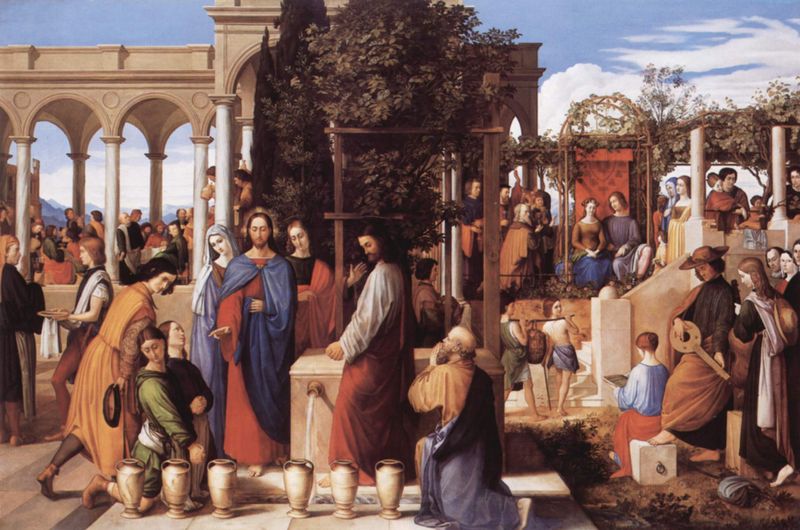
But there is another glory.
It fadeth not away.

Friday, June 18, 2010

The Prayer at the Wedding


““. . . the mother of Jesus said to Him, ‘They have no wine’.”
(John 2:3)

We inevitably remember the Wedding Feast at Cana as the story of Jesus’ first miracle.
John normally used the word “sign” to designate Jesus’ mighty acts, because he wished to emphasize the particular message clothed in the miracle. The water-to-wine miracle was Jesus’ first sign , but it was not the first display of His supernatural capacity in John’s gospel. He’d already displayed a miraculous knowledge of Nathaniel in chapter 1.
Jesus never indulged anything remotely like magic, and His miracles were never random or without a message. Every sign was like a little parable telling of His person, power and purpose. The episode at the wedding also carries a lesson about prayer, because the emergency was met by a miracle summoned by a prayer. The prayer was a marvel of succinctness hidden in the form of an observation. It was prayed by Mary who summed the situation up in four words:
“...they have no wine.”
We hear only an observation; Jesus, however, hears a request. How else are we to understand His answer in John 2:4: “Woman what am I to do with you, My time has not yet come”?
We will be helped in our understanding of the gospels if we remember that Jesus seldom responded to words alone; He responded rather to thoughts. Have you ever noticed how sometimes Jesus appears to utter a non sequitur—i.e., an answer apparently unrelated to the question or a comment apparently out of place in the context? We see this again later in chapter two when the authorities in Jerusalem challenge His right to cleanse the Temple. Jesus’ response to them was a little mysterious: “Destroy this Temple and in three days I will raise it up” (John 2:19). But He was responding to their thoughts, as they were already thinking that He must die for opposing them.
We frequently use our words to throw a cloak over our true thoughts, but Jesus cuts through the artifice to address the real issue. Back to the wedding passage: if it were anyone else but the Lord, we would be tempted to think Mary was being treated with undue abruptness. After all, she was simply making an observation—or so it seemed on the surface. But the Lord is never interested in the surface. When He speaks to us, deep calls to deep. His response to Mary signals that what His mother may have wanted was some sort of disclosure of His full identity and office. The moment may have seemed propitious to her. But that the moment was premature is evident from His answer: “My time has not yet come.” When she speaks we can only hear an observation, but we can be sure that He heard a request. Characteristically she responds to His apparent rebuff with faith: she alerts the servants to be ready to obey His every command.
While we only hear a “no” in Jesus’ answer, Mary hears a “yes.” This is obvious from her response. She actually gives the servants the best counsel ever given in the history of the world: “Whatever He says to you: DO IT!” (John 2:5).
Perhaps Jesus did not do everything her heart could wish for. But He did something. And He met the need of the hour.
Now here is a remarkable thing and a lesson for every believer. What is our response when we believe God is telling us “no”? What do we do when we suspect He may not give us exactly what we want? The lesson from Mary, as relayed through her instructions to the servants, was simply this: if we think God is saying “no” to us we must be sure we are still saying say “yes” to Him. If we are disappointed, it is all the more urgent to insure that He is not disappointed.
Can we truthfully say that it is more important that we do what the Lord wants us to do than He do for us what we want Him to do? It’s no use pretending: our prayer life will only sustain one great burden. And while it’s certainly permitted to pray for God to act on our behalf, it’s a bad symptom if that one theme dominates our entire agenda.
Let us be confident that even if we can’t be sure He will give us what we want, He will do something. And that something will be a good thing and a better thing (though we may not see it) than what we asked. Let the burden of our prayer life be a determination to do what the Lord wants.
When we reach that place in prayer, we will witness the power of God. Indeed if we reach that place, we will have already witnessed it. The supply will be filled. The celebration will continue.
Just as it did at Cana.

Thursday, May 6, 2010

The National Day of Prayer


El Greco
Agony in the Garden

Much has been made of President Obama's non-participation in the National Day of Prayer on May 6th. The published reason for opting out is fear of offensiveness. Would that there were more fear of offending Almighty God.
As for prayer itself we must pray when we feel like it because motivation is a gift. We should also pray when we don't feel like it because apathy is a warning. ‘Pray without ceasing,’ the great Apostle wrote. Almost anything is easier than real prayer. The world, the flesh, and especially the devil rise up. We are opposed. I also know it's easier to teach on prayer than to pray. I think one mistake we make is to compartmentalize prayer and Bible study. When I read I can pray more and when I pray I can read more. It's like food and drink at table. One stimulates the other.
There is much to pray about. The United States is at war in two separate theatres. There’s an election in the UK today. Greece, the cradle of democracy, is bankrupt and on the verge of imploding. The Gulf of Mexico is awash with oil. And these are just the public concerns.
The private concerns of our heart compel prayer the more. Samuel Johnson wrote that a man is never so sincere as when he prays for himself. The health of our bodies, the solvency of our finances and the tranquility of our families dominate the prayer map for most of us. Does God not have our attention when there's a crisis with our children? You bet He does.
It's an eye-opener to survey the prayers and the exhortations to pray in the New Testament. The courage of personal witness, the strength to persevere, and the advance of the Kingdom are typical emphases. Comparing the New Testament prayer agenda to our own may be a convicting exercise.
There is much yet to be learned about prayer. The subject is replete with mystery. Our understanding will doubtless advance while we pray. When we consider what is offered in response to this great thing called prayer it is obvious that the promises are bigger than our realizations. I wonder if that's because a casual and cursory approach to prayer --like checking items off a list --is not really prayer at all. I remember being reproved after a sermon many years ago. I had remarked that we have no Revival because we have no prayer. A lady (with a reputation for godliness) asked how that could be true since she prayed for Revival-what exactly did I mean? I told her that the last real Revival in the West was the Welsh Revival of 1904-05. The Welshman Evan Roberts began praying in 1893. He would pray up to four hours a day and did so for eleven years. After eleven years the fire fell.
How different is my own prayer life from that of Evan Roberts. How different is my own languid offering from the agony which sweat blood in Gethsemane.
In any case prayer must be our own emphasis.
Oswald Chambers wrote "Prayer does not prepare for the great work. Prayer is the great work."
Prayer must be our priority. Martin Luther said "I have so much to do today I'll probably have to spend half the day praying."
Most importantly prayer is the way to nurture our relationship with the Lord.
That relationship is best served when we major on thanksgiving and praise rather than simply dropping off our list of things we want God to do for us today. Tell Him what you want, to be sure (Phil. 4:6), but major on thanking Him for what He's already done and praising Him for the same.
Come into His presence with singing and into His courts with praise.
He would be worthy of our worship were we not conscious of even one answered prayer.
Let us pray on the Day of Prayer then.
The Church of Jesus Christ advances on its knees.