The wrestling angel gifted Jacob with a limp as a permanent reminder of his encounter with God. Jacob's life-long policy was to run. His final glory was that he learned to lean (Hebrews 11:21). A wound is a good thing if it is accepted as a stewardship from God, appropriated as a channel of God's strength and consecrated to God's purpose. Where dependence is the objective weakness is the advantage.

Friday, June 18, 2010

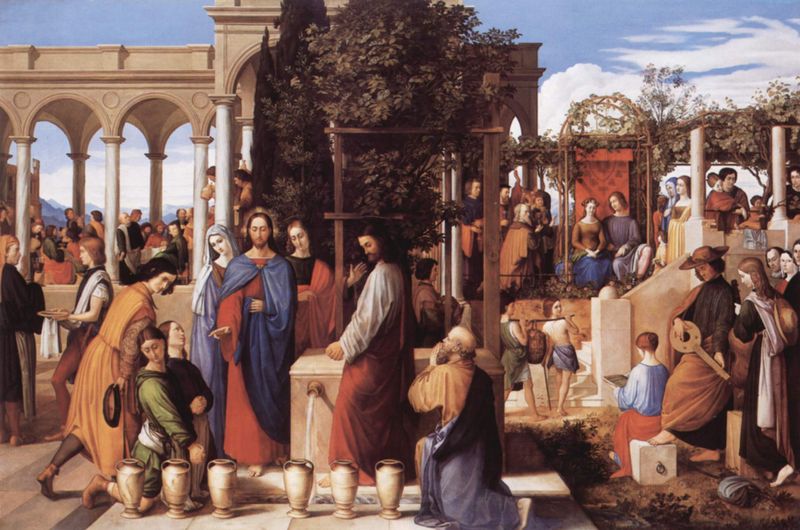
The Prayer at the Wedding


““. . . the mother of Jesus said to Him, ‘They have no wine’.”
(John 2:3)

We inevitably remember the Wedding Feast at Cana as the story of Jesus’ first miracle.
John normally used the word “sign” to designate Jesus’ mighty acts, because he wished to emphasize the particular message clothed in the miracle. The water-to-wine miracle was Jesus’ first sign , but it was not the first display of His supernatural capacity in John’s gospel. He’d already displayed a miraculous knowledge of Nathaniel in chapter 1.
Jesus never indulged anything remotely like magic, and His miracles were never random or without a message. Every sign was like a little parable telling of His person, power and purpose. The episode at the wedding also carries a lesson about prayer, because the emergency was met by a miracle summoned by a prayer. The prayer was a marvel of succinctness hidden in the form of an observation. It was prayed by Mary who summed the situation up in four words:
“...they have no wine.”
We hear only an observation; Jesus, however, hears a request. How else are we to understand His answer in John 2:4: “Woman what am I to do with you, My time has not yet come”?
We will be helped in our understanding of the gospels if we remember that Jesus seldom responded to words alone; He responded rather to thoughts. Have you ever noticed how sometimes Jesus appears to utter a non sequitur—i.e., an answer apparently unrelated to the question or a comment apparently out of place in the context? We see this again later in chapter two when the authorities in Jerusalem challenge His right to cleanse the Temple. Jesus’ response to them was a little mysterious: “Destroy this Temple and in three days I will raise it up” (John 2:19). But He was responding to their thoughts, as they were already thinking that He must die for opposing them.
We frequently use our words to throw a cloak over our true thoughts, but Jesus cuts through the artifice to address the real issue. Back to the wedding passage: if it were anyone else but the Lord, we would be tempted to think Mary was being treated with undue abruptness. After all, she was simply making an observation—or so it seemed on the surface. But the Lord is never interested in the surface. When He speaks to us, deep calls to deep. His response to Mary signals that what His mother may have wanted was some sort of disclosure of His full identity and office. The moment may have seemed propitious to her. But that the moment was premature is evident from His answer: “My time has not yet come.” When she speaks we can only hear an observation, but we can be sure that He heard a request. Characteristically she responds to His apparent rebuff with faith: she alerts the servants to be ready to obey His every command.
While we only hear a “no” in Jesus’ answer, Mary hears a “yes.” This is obvious from her response. She actually gives the servants the best counsel ever given in the history of the world: “Whatever He says to you: DO IT!” (John 2:5).
Perhaps Jesus did not do everything her heart could wish for. But He did something. And He met the need of the hour.
Now here is a remarkable thing and a lesson for every believer. What is our response when we believe God is telling us “no”? What do we do when we suspect He may not give us exactly what we want? The lesson from Mary, as relayed through her instructions to the servants, was simply this: if we think God is saying “no” to us we must be sure we are still saying say “yes” to Him. If we are disappointed, it is all the more urgent to insure that He is not disappointed.
Can we truthfully say that it is more important that we do what the Lord wants us to do than He do for us what we want Him to do? It’s no use pretending: our prayer life will only sustain one great burden. And while it’s certainly permitted to pray for God to act on our behalf, it’s a bad symptom if that one theme dominates our entire agenda.
Let us be confident that even if we can’t be sure He will give us what we want, He will do something. And that something will be a good thing and a better thing (though we may not see it) than what we asked. Let the burden of our prayer life be a determination to do what the Lord wants.
When we reach that place in prayer, we will witness the power of God. Indeed if we reach that place, we will have already witnessed it. The supply will be filled. The celebration will continue.
Just as it did at Cana.

Thursday, May 6, 2010

The National Day of Prayer


El Greco
Agony in the Garden

Much has been made of President Obama's non-participation in the National Day of Prayer on May 6th. The published reason for opting out is fear of offensiveness. Would that there were more fear of offending Almighty God.
As for prayer itself we must pray when we feel like it because motivation is a gift. We should also pray when we don't feel like it because apathy is a warning. ‘Pray without ceasing,’ the great Apostle wrote. Almost anything is easier than real prayer. The world, the flesh, and especially the devil rise up. We are opposed. I also know it's easier to teach on prayer than to pray. I think one mistake we make is to compartmentalize prayer and Bible study. When I read I can pray more and when I pray I can read more. It's like food and drink at table. One stimulates the other.
There is much to pray about. The United States is at war in two separate theatres. There’s an election in the UK today. Greece, the cradle of democracy, is bankrupt and on the verge of imploding. The Gulf of Mexico is awash with oil. And these are just the public concerns.
The private concerns of our heart compel prayer the more. Samuel Johnson wrote that a man is never so sincere as when he prays for himself. The health of our bodies, the solvency of our finances and the tranquility of our families dominate the prayer map for most of us. Does God not have our attention when there's a crisis with our children? You bet He does.
It's an eye-opener to survey the prayers and the exhortations to pray in the New Testament. The courage of personal witness, the strength to persevere, and the advance of the Kingdom are typical emphases. Comparing the New Testament prayer agenda to our own may be a convicting exercise.
There is much yet to be learned about prayer. The subject is replete with mystery. Our understanding will doubtless advance while we pray. When we consider what is offered in response to this great thing called prayer it is obvious that the promises are bigger than our realizations. I wonder if that's because a casual and cursory approach to prayer --like checking items off a list --is not really prayer at all. I remember being reproved after a sermon many years ago. I had remarked that we have no Revival because we have no prayer. A lady (with a reputation for godliness) asked how that could be true since she prayed for Revival-what exactly did I mean? I told her that the last real Revival in the West was the Welsh Revival of 1904-05. The Welshman Evan Roberts began praying in 1893. He would pray up to four hours a day and did so for eleven years. After eleven years the fire fell.
How different is my own prayer life from that of Evan Roberts. How different is my own languid offering from the agony which sweat blood in Gethsemane.
In any case prayer must be our own emphasis.
Oswald Chambers wrote "Prayer does not prepare for the great work. Prayer is the great work."
Prayer must be our priority. Martin Luther said "I have so much to do today I'll probably have to spend half the day praying."
Most importantly prayer is the way to nurture our relationship with the Lord.
That relationship is best served when we major on thanksgiving and praise rather than simply dropping off our list of things we want God to do for us today. Tell Him what you want, to be sure (Phil. 4:6), but major on thanking Him for what He's already done and praising Him for the same.
Come into His presence with singing and into His courts with praise.
He would be worthy of our worship were we not conscious of even one answered prayer.
Let us pray on the Day of Prayer then.
The Church of Jesus Christ advances on its knees.

Friday, April 9, 2010

The Number of Greats Diminished by One


Mark Ashton July 18, 2009

Did you hear the story of the Pastor driving home from church lamenting to his wife that there simply were not many great preachers left in the world? She nodded sadly and informed him there was even one less than he thought.
Mark Ashton, Vicar of The Round Church meeting at St. Andrew the Great Cambridge, was a great preacher. Humility does not always adorn the pulpits of the great. But this was one of those rare impressive men who was wholly unimpressed with himself.
Mark entered heaven on what some Christians call Holy Saturday, the day between Good Friday and Easter. April 3rd 2010. He was 62 years old.
I remember the exact date I first heard Mark preach. It was The Lord's Day 26 March, 2006. Easy to remember because it was our wedding anniversary and Jane was with me. We'd gone to another Cambridge Church in the morning, but we made it to STAG for the 5pm service. It was between terms so the students were away from Cambridge. You can imagine my surprise when we entered a church packed with young people. The music was wonderful. A spirit of worship prevailed in the congregation.
The minister approached the platform and proceeded to amaze me. He read from Numbers 19 and delivered a verse by verse exposition on the subject of the Red Heifer. THE RED HEIFER! From Numbers! In the context of successive expository messages though the Fourth Book of Moses. To young people mainly. In the 21st Century. To a packed house.
The sermon was magnificent.
I felt dazed and grateful.
I determined there and then that Mark Ashton would be my friend.
It was not unlike the doctrine of Election. He did not choose me; I chose him.
Later that summer we did ministry together with students in the Czech Republic.
Just before his diagnosis he agreed to come and minister in our church in Budapest, a prospect abandoned as the cancer closed in. His last sermons in January were from the Book of Acts.
Mark had the bearing and carriage of an athlete which, in fact, he was. His first degree was from Oxford but he later rowed for Cambridge where he took his theology degree. He was one of those robust personalities we have trouble associating with illness and death. There are few things harder to trust God with than this business of who dies early and who stays late. Who but God could discharge a responsibility so grave?
But we do trust Him, because we must trust Him.
But just because we trust, that doesn't mean we don't grieve.
And we grieve most deeply.

Your beauty O Israel is slain upon your high places
Tell it not in Gath
Publish it not in the streets of Ashkelon
I am distressed for you my brother
You were very pleasant to me
How are the mighty now fallen
While the battle rages still

Sunday, April 4, 2010

Easter and the Point of it All


He is Risen – The First Easter
Arthur Hughes (1893)

He is not here; for He is risen. Just as He said.
Matthew 28:6

The atheist protests that God (the One Who, by skeptic reckoning, was never there) should have created a far different world than the world we now have. I can fathom no reason why God should adjust His sovereignty to accommodate the bellowing of ranters. But in point of fact He did create a world which would be unrecognizable to us today.
In that Original Creation death was nowhere to be found. Everything teemed with life. Throbbing, pulsating, prolific life. Literally everything in that system collaborated for the sustenance of human happiness. The elements themselves, the beasts of the field, the things which creep and those micro-organisms invisible to our sight were either benign or salubrious in their impact on the health of human-kind.
In the first Garden death was a nullity unregistered in history or experience. Because it was unexperienced and unwitnessed it was a thing scarcely to be imagined. Death existed, if we may use the word 'existed' in such a manner, in only one place, and that place was the Word of God. More precisely death existed solely in a Warning by God. And that warning was localized in a Tree and the fruit which hung thereon. Eat of the fruit of that tree said the Lord and in the day you eat of it, dying you shall surely die.
Of course the world as it is today is precisely the opposite to what we have read of that Paradise of Innocents. Everything tends toward death. Every person ever born (Enoch and Elijah excepted) is either dead or will die. It is the one great commonality in our history and the one great certainty in our future.
Life after the grave, the triumph over death at the end, is found in only one place: In the Word of God. As far as our hope for life goes the Promise is localized upon one tree and the one Man who hung thereon. That tree was the Cross, and the Man Who died there is Jesus of Nazareth. It is only by faith believing God's Promise that death will be cheated and the grave plundered.
We will not here trace the various threads of evidence which lend credence to biblical miracles.
Our question is a simple one. Why was Christ raised? To give Him life? Not in the ultimate sense. Christ already possessed Life which was eternal, non-contingent and unalienable.
No man takes My life from Me. I lay it down. (John 10:18)
His resurrection was not necessary to secure His own life for the simple reason that His death was not necessary. It was rather voluntary.
The resurrection was necessary to secure life for the sinner.
He was raised for our justification.
Before the throne my Surety stands.
My name is written on His hands.
Christ is risen that I too may rise.
Having died with Him by faith I will reign with Him in glory.
Such is the promise, such are the prospects.
The warning went unheeded let not the promise go unclaimed.
Christ is risen as our hope.
There is no other recourse.
Nor would we want one if there could be.

Friday, April 2, 2010

Darkness at Noon

Good Friday


Now from the sixth hour there was darkness over all the land until the ninth hour.
Matthew 27:45

The list of early adherents who later renounced Communism in the 20th Century is long. Some were disillusioned by the Ukrainian famine, others by the Nazi-Soviet Pact, still others by the hard fact (empirically demonstrated) that reality never measured up to theory. Many traced their awakening in memoirs: George Orwell, Whitaker Chambers, and Joy Davidman among others. One of the most prolific and profound of that number was Arthur Koestler, the Hungarian Jew who wrote 'The God that Failed.' His fictional account of the Moscow show trials was called 'Darkness at Noon’. Those trials were an exercise in judicial murder. Koestler's novel was an imaginary account of an historical tragedy.
Centuries earlier Matthew, Mark, Luke and John wrote historical accounts of a spiritual tragedy.
THE spiritual tragedy.
They too recorded a judicial murder.
They wrote of a day which really did know darkness at noon.
Christianity finds the fulcrum of its persuasive power in the real-time events of Crucifixion and Resurrection in Palestine at Passover in the First Century.
It is essential to the claims that the critical episodes unfolded in plain view. They were public spectacles. Jesus fed five thousand and appeared to five hundred. The fire fell on Jerusalem at Pentecost when the place was thronged with pilgrims. If you play at deception better to make the lie obscure and difficult of disputation.
But it wasn't deception.
That being the case, why, we may well ask, was the critical moment shrouded in darkness?
Scripture does not tell us outright but we may guess.
The first reason is DECORUM.
The Crucifixion was not simply the execution of the man Jesus. It was also the killing of our Maker. The crime was an attempt to uncreate the Creator. Imagine a book trying to annihilate its author. I know it's absurd. Absurd, but also monstrous. Unnatural, but also a travesty.
I submit that there is something beyond metaphor when Isaiah writes of the trees clapping their hands. Jesus speaks of the stones crying out and Paul informs us that creation groans. Poetic license merely? I think not. Enormous hints are being given.
Jesus would have remembered an original condition. And Paul was writing of a present reality.
Why was it dark?
It was dark because you don't wear bright colors to a wake.
CREATION WAS IN MOURNING.
It was only right for the sun to hide its face.

The second reason is DISCRETION.
One of the first foreshadowings of the dread day was the journey of Abraham and Isaac to Moriah. When they drew close the stricken father ordered those who accompanied them to stay behind. This was to be a family matter-something between father and son. The Covenant which brought our Redemption was ratified in Eternity Past before there were human witnesses. That plan was worked out at the Cross where the witnesses were uncomprehending. In the words of Jesus they simply did not know what they were doing.
Even with the sixty-six canonical books, even with two thousand years of the Holy Spirit's gracious disclosure to students of Scripture and their attendant theological reflection, there is much still beyond us. We stammer at the borders of human utterance. We bump up against the limits to human understanding. The astronomer strains to the capacity of the best telescope He concedes a nether darkness toward which the first stars flee. He can't see past them as they recede. We appreciate his position. We too would see more. God the Son has died. Tis mystery all, the Immortal dies. Human salvation has been secured by the cruelest of human sins Died He for me who caused His pain for me who Him to death pursued.
This is a transaction between God and God. Who can explore His strange design? In vain the first born seraph tries to sound the depths of love divine. Amazing love how can it be? That Thou my God hast died for me.

It was dark that day between twelve and three.

The third reason is DECREE. It was required that the Passover Lamb be slain at twilight. (Exodus 12:3-6)
They hung Him high in the morning.
So God sent twilight to the middle of the day.
God's purpose could not be frustrated.
God's Law would not be broken.
Not in this Man's Life.
Not by this Man's Death.
He died in darkness that we might live in Light.
Hallelujah.
Hallelujah
...for this Jesus.

Thursday, April 1, 2010

Learning from Nationals


Abram and Melchizedek
Peter Paul Reubens (1625)

Chaucer, Browning, Eliot and Paul Simon all wrote about April. This year April relieves a winter unusually rugged by European standards.
Like January, March ripped past while I was looking the other way. Our family has lots of March birthdays and anniversaries. Travel made the month a blur. I saw California's coast and the Pacific coast of China without ever crossing that ocean.
March ended on an up note. Yesterday the Daily Telegraph reported that Christopher Hitchens’ younger brother has written a repudiation of the atheistic rants which appear all too frequently from Christopher’s obnoxious pen. The Rage Against God is the name of the new work by Peter Hitchens, himself a former atheist. Since the book won’t be available till May 1st, I have no idea whether the effort is sufficiently biblical or even Christian. I was somewhat daunted by a comment in the pre-pub video. Peter suggests that Christopher is beginning to soften. But the only evidence he offers is that the atheist has quit smoking. Self-preservation is always a wise policy for an atheist, but it doesn’t necessarily signal a move toward theism. Still, news of the forthcoming book is exciting, and it gives us hope of better things from the Hitchens family.

March leaves me with another positive memory.
Missionaries are supposed to teach, not just so we can leave behind students but so we can leave teachers in place long after we depart .It's an exquisite feeling to learn from someone who once learned from us. One Hungarian I work with often gifts me that experience. I baptized him over 20 years ago. Now he takes me to school.
Whenever I meet with a National I nearly always ask, “Tell me what you’re learning in Scripture." When I ask this particular friend I always reach for my notebook.
This last time he took me to Deuteronomy 17. (You remember Deuteronomy 17 don't you?)
In that place Moses is instructing Israel on the ways of kings, warning against false hopes for success as a nation.
First he warns against the tendency of kings to depend on military prowess. "...he shall not multiply horses to himself." v.16. Thus the key for Israel would not be military.
Then he mentions the false hope of political alliances."Neither shall he multiply wives to himself..." v.17. Presumably the motive for multiplying wives was not merely biological. It was the habit of those ancient monarchs to forge alliances by marrying the sisters and daughters of foreign rulers.
Moses intimates that security for Israel could not be gained in that way. Inter-marriage among European ruling houses was especially fashionable in the 18th and 19th Centuries. It proved no safeguard against World War I --which George Will called "The war to save the world from Queen Victoria's grandson."
Finally Moses warns against the hoarding of wealth- a tendency definitely not limited to kings. "... neither shall he greatly multiply to himself silver and gold." (v. 17b)
If a nation is not to hope in strength along military, political or economic lines where exactly does strength come from?
"It shall be when he sits upon the throne of his Kingdom that he shall... copy this law in a book...and it shall be with him. and he shall read therein all the days of his life; that he may learn to fear the Lord his God...that his heart may not be lifted up above his brethren, that he may prolong his days in the Kingdom, he, and his children , in the midst of Israel."
It's a wonderful lesson is it not?
Not only for Kingdoms but for ministries, and for families.
What a pity that it's a lesson universally unheeded.
It's a thing worth noting that Jesus vanquished the tempter in the wilderness by quoting two passages in Deuteronomy. Having been given food will we not take it in? Having been given armor will we not put it on?
More tomorrow during THIS HOLY WEEK.

Saturday, February 13, 2010

February Already

January flew by as a month unremarked upon. I was distracted by a short trip to the Mid-East in the middle and travel to the US at the end. It would have been hard to write in January without mentioning Haiti. The last entry of 2009 was taken up with suffering. I found the prospect of an encore daunting. Sometimes it's better to simply weep and pray and leave the commentary to others. We've long heard that Haiti is the poorest country in the Western Hemisphere. How do we conceive of those who have nothing losing everything? New Orleans bounced from Katrina to the Super Bowl. It's difficult to conceive of Haiti bouncing anywhere very high.

Years ago I had contact with a brilliant RAF officer, eccentric, unmarried and a believer. He was a Cambridge graduate and a fluent Russian speaker. At a wedding we both attended at the Air Force Academy he was holding forth (apropos of what I can't remember) on the subject that Haiti was dedicated to the devil at its founding. That was news to me and I never thought about it again until I heard that some were attributing Haiti's earthquake to its alleged diabolical origins.

Linking specific suffering to specific sins is a hazardous enterprise at best. Unless the link is direct (as in crime/punishment, drunkenness/accident etc) I think proving a connection is beyond the scope of human competence. There are innocents who have no knowledge or sympathy with the darker components of Haiti's founding (or their parents' HIV or something similar) who suffer dreadfully. And there are those who sin dreadfully who seem to be eluding immediate consequences in the short run. Suffice to say that in these mortal bodies, on this fallen planet, suffering is our lot until the coming of the Son of Man. Even so come quickly Lord Jesus.

The snow is heaped high here. I am in Budapest and Jane is in Florida. Good for her but a tough Valentine's Day assignment for me. One of our best memories as a couple is taking the train from Munich to Vienna on February 14, 1986, on our first visit to Austria. It's a five hour run through some beautiful countryside. It was snowing that day and the train stopped in St. Valentine Austria, a city whose existence I knew nothing about until the train pulled into the station.

Christians may overlook or underestimate romantic love. But it's a nearly overwhelming thing which has inspired the forlorn, the sublime and the dastardly for all our history. The Bible first mentions such love in describing what Jacob endured for Rachel.

The first mention of any kind of love in the Bible bears no trace of the romantic. Nor is it, as we would guess, the love of God for man or the love of man for God. It is rather the love of a father for a son in the most excruciating of contexts.

"Take now your son, your only son, the son whom you love..."

Genesis 22:2

When we take it upon ourselves to ask how a Son infinitely loved could be a Son actually sacrificed we begin to gaze upon the heart of Reality.

We begin to get at the root of things.

Now may the romance of Valentines compensate for the cold of February.

And if romance seems no part of your life remember that the Gospel itself is a romance.

The Church is, after all, a Community Betrothed.

If we are not consciously and conscientiously awaiting the Heavenly Bridegroom the only thing we've missed is the point.

So let us wait with longing and with faith.

We expect the consummation of the greatest Romance (theological not biological).

I am quite sure the weather will improve as well.