The wrestling angel gifted Jacob with a limp as a permanent reminder of his encounter with God. Jacob's life-long policy was to run. His final glory was that he learned to lean (Hebrews 11:21). A wound is a good thing if it is accepted as a stewardship from God, appropriated as a channel of God's strength and consecrated to God's purpose. Where dependence is the objective weakness is the advantage.

Saturday, December 11, 2010

Something to Share near Christmas


John Stott (April 27, 1921-)

I just listened to a 2002 Christmas sermon preached in London by John R.W. Stott. We're two weeks out and counting and I'd be pleased to hear a message like that every day until the 25th. John Stott may be our best living preacher in English. He's definitely in the top five. He'll be 90 next year, and he won't be a part of our world much longer. I believe his insights are too good to hoard.
The text was Matthew Two--The Visit of the Magi. I found the outline headings especially striking and wish them to be widely known. So I will share those headings followed by one or two personal observations. Anything lucid or helpful has to be from Stott. If it's muddled or off the mark assume it's mine.

I. No trouble is too great to seek Him.
It's snowed all day in Budapest. To render a small service to my King I faced the weather this morning and returned in a self-congratulatory mood. Then I listened to the story of the Magi. What was my inconvenience compared to their own? They embraced the weariness of distance, danger from the elements, danger from animals, danger from brigands. They didn't know their destination having only a general orientation .They didn't know His Name. They only knew they must find Him. And, appropriating God's help, find Him they did.

II. No people are too alien to find Him.
They were searching for the King of the Jews. They were certainly not Jews themselves. How common would it have been to search for a foreign king for the purpose of worship? The Jews were a conquered people. Why pay fealty to their King?
Under this heading the preacher made an assertion sure of disputation. I don't intend to defend the assertion; I only want to publicize it. As the observation is so politically incorrect it is necessary to emphasize that JRW Stott is not a right-winger from the Bible Belt. He took a Double First at Cambridge. His politics are decidedly left of center. He is a Socialist and a Unilateralist. He is a Pacifist who refused military service in WWII thus alienating himself from his own soldier father for years.
And yet in his message JRWS declared that Christianity is the only major non-ethnic religion .I don't expect much contention on that score from Hinduism, Buddhism, Judaism, Shintoism, or Confucianism. From Islam I can well imagine something more aggressive than a slight demur. But Islam took root among the Arab people and those they conquered. The fulcrum of Islam's power was found at the point of a sword not in historical legitimacy or moral suasion. Whatever the personal faith of its adherents Islam was a useful apologetic in the service of Arab expansionism. Timothy Keller is fond of saying that Jesus' message was "Crown me or Kill Me." The Muslim message was "Convert or Die."So the potential for its message to convert beyond the Arab peninsula without the use of force must remain a hypothesis contested.
The Magi were likely practitioners of astrology or occultic arts. The very name suggests a kinship to 'magic.' But they came to worship Jesus. If they could be reached no one is beyond the pale.

III. No gift is too precious to give Him.
We are impressed by the variety of the gifts, the value of the gifts and the significance of the gifts. By significance I mean merely this. The requirements for the altar in Exodus 30 included elements of gold , frankincense and myrrh. The altar-- the place where the sacrifice was laid and atonement was made. Did they know or was the significance unwitting? We can't be sure but it doesn't matter. It is enough that God knew and that He orchestrated the thing. It is enough that we know and adore.
Though we can't be certain precisely what they knew it has been conjectured that they accessed Daniel's writings and ascertained the general time period.
It is hard to read:
"Where is He who has been born King of the Jews? For we have seen His star in the East and are come to worship Him." Matthew 2:2
--without imagining that they had somehow read:
"For unto us a Child is born, unto us, a Son is given, and the government shall be upon His shoulder, and his Name shall be called Wonderful, Counselor, the Mighty God, the Everlasting Father, the Prince of Peace." Isaiah 9:6
They were looking for a King, perhaps because they knew the government would be upon His shoulder. They were intent upon worship, perhaps because they knew it was right to call Him 'The Mighty God.'
They didn't know everything but they knew enough to begin a quest highly rewarded.
Having read their story we share their reward.
Would that we would imitate their worship.
Before we even begin we know more with less effort than they knew after they arrived.
What obligations are placed upon us by that knowledge.
And what privilege.

John Stott - The King Who is Shepherd

Monday, November 1, 2010

The Murders at Church


Martin Luther
(Nov. 10, 1483-Feb. 18, 1546)


Ignatius Loyola
(1491-July 31, 1556)

I've only been to Baghdad once. I do sometimes frequent the safer havens in Northern Iraq where Kurds control and (most of the time) Americans are welcome. In that one brief Baghdad visit (to secure a visa before heading North) the small plane from Amman landed in a sudden corkscrew motion. I naively asked the flight attendant (young, male, South African and Christian) if the odd angle was for fuel economy.
"No, he answered.”It's to make us a harder target for RPG's."
RPG's are Rocket Propelled Grenades.
I decided at that point to give Baghdad a miss in future visits.
So far I’ve managed never to return.
So much for Missionary heroism.
Yesterday was an unusual Reformation Day for me. First, in our own Service of Worship, there was a dramatic portrayal of Martin Luther nailing up the Ninety-Five Theses. After the service Jane and I watched the first half of the Ralph Fiennes movie on Martin Luther. We'd already seen the film but enjoyed the second go-round. We left early because we had an evening commitment in a Hungarian Protestant Church- a Reformation-Day Concert (Bach and Vivaldi).The homily was delivered by a Jesuit Priest. I was amazed by the limitless boundaries of ecumenism. Afterwards I asked the preacher if he thought Ignatius Loyola (founder of the Jesuits and spearpoint of the Counter-Reformation) would have spoken in a Protestant Church on Reformation Day. He said he didn't know but I think he did know. I think Loyola would have gladly spoken in any Protestant Church but only after he had arrested the worshipers.
I am not eager to go out of my way to pick fights with Catholics. Neither am I willing to minimize the fierce differences which remain. It does no good to insist that we preach the same Gospel.
We don't.
That said there comes a time to salute and even praise those with whom we disagree.
Such a time has come.
Last night about the time we were attending the Reformation Day service in Budapest terrorists took over a Roman Catholic service in Baghdad. The death toll now stands at 52. It may rise. Many who claim Christian affiliation have emigrated from Iraq. Most Christians have fled Baghdad. There remains though an intrepid remnant who not only stay but worship. That number was cruelly diminished last evening not by flight but by slaughter.
Of those Roman Catholic worshipers in Baghdad I can only declare that I mourn their blood.
I praise their courage.
And I want to follow their example.
God help the grieving family members and the wounded.
God help us all.

Tuesday, October 12, 2010

FF Bruce at 100


Frederic Fyvie Bruce, the greatest biblical scholar of his generation, was born one hundred years ago today in Elgin, Scotland. I well remember my sense of loss at his death in the autumn of 1990 within about 30 days of Philip Edgcumbe Hughes' death, another noteworthy evangelical commentator. I was stung then by the diminution of evangelical firepower. I reflect now upon the great gift FF Bruce was to the church. I well remember the first flurry of impressions of Professor Bruce I had as a new Christian. In his apologetics Josh McDowell leaned heavily on FF B's 'The New Testament Documents: Are they Reliable?' I remain in awe of the breadth of Prof. Bruce's scholarship.

His major strength was New Testament Greek and the field of Textual Criticism. But he also took a Gold Medal in Hebrew at Cambridge. His undergraduate Classical Studies were at Aberdeen. He gained a mastery of German at the University of Vienna. He visited Hungary in the Thirties and wrote about it in his Autobiography. Like CS Lewis he never took an academic doctorate though he navigated many a young scholar through doctoral studies. His English prose style was not remarkable but I was taken at the name of one of his volumes of Church History. He called it 'The Spreading Flame.'

Later he wrote an Introduction to a book by Dewey Beegle which featured an unfortunate view of biblical authority. I am not competent to speculate on his reasons or what that Introduction signaled about his own views. But I can't imagine he would have agreed with every jot and tittle of the dozens of books he wrote introductions for.

In the early 80's I was desperate for help on an illustration from ancient history. It was Sunday morning and the service was about to begin. In those dark pre-internet days when we actually had to look things up in books I realized that I'd not budgeted enough time to find what I was looking for. I couldn’t share the illustration with insufficient data. So I tried to shelve the idea. But I couldn't get the thing out of my mind. I remembered that somebody or other somewhere or other for some reason or other drew a line around somebody in the sand. I wanted to use the story as an evangelistic exhortation.

Running out of time at about ten to eleven I picked up the phone and dialed Manchester, England Directory Assistance. Amazingly I was given his number. Even more amazingly he answered the phone. After profuse apologies for intruding upon his Sunday afternoon I supplied the embarrassingly vague outline.
"Do you know the story?"I asked.
"Oh yes, oh yes," he replied.
"Can you help me then?"
"Oh yes ,oh yes."
He commenced,"168 BC Antiochus Epiphanes of Syria took advantage of the Roman preoccupation with the Punic Wars and invaded Egypt. The Roman Senate dispatched a delegate named Lysias to Egypt to order Aniochus out. They met on the beach. Lysias declared 'By order of the Roman Senate and People I command you to leave Egypt.'
Antiochus said, 'I’ll think about it.'
'Fine,' said Lysias. 'Think about it all you want.'
Then, drawing a circle around him in the sand on the beach, he added, 'Just make your decision before you step outside that circle.'
Antiochus left Egypt.
And the authority for this," said FF Bruce, "is the Greek historian Polybius."
"Well Professor Bruce," I responded, "this just proves an American rumor."
"And what rumor is that?" he asked.
"The rumor that you know everything."
He didn't know everything.
But he came close.
On his hundredth I thank God for the consecrated and generous scholarship which his life brought to biblical studies.
For over twenty years I haven't known who to call.
Perhaps we were given the Internet as a compensation.
But that's hardly an even trade..

Tuesday, September 14, 2010

Little Things That Happen


(October 15, 1881 – October 26, 1944)

William Temple, one time Archbishop of Canterbury, records a wry observation about prayer. He said that when he prayed strange coincidents occurred. And when he failed to pray they did not.
Inspiration-wise this is hardly radical stuff. Not quite the thing to launch the troops up over the ramparts. He may just as well have said, "Two cheers for prayer."
It falls short of the bold vehemence of a promise like:
"Ask anything in My Name and I will do it."
I can honestly think of only one reason to commend the quote:
It happens to be true.
Before I left for a trip to the Czech Republic on August 26th, Jane and I prayed. For some reason we began praying for friends infected with Lyme's Disease, though we'd received no recent requests. Jane's younger brother has suffered for years and three friends in Memphis have endured long out-of-state hospital stays trying to shake free of it. We talked about Lyme's after we prayed and it struck me as odd that the emphasis should emerge out of nowhere on that particular morning.
Entering Budapest Keleti Station (the place where Hercule Poirot was standing at the beginning of 'Murder on the Orient Express') I heard the delightful news that the train was three hours late. I settled in for the grim wait and struck up a conversation with a 35 year old Czech going home to Prague. He told me he owned a tea company and asked what I do. I usually try to draw that one out and stimulate a little curiosity, but this time I gave in quickly and admitted, "I'm a Bible teacher." He brightened noticeably.
Not the response I'm used to.
"I've just come from my doctor and he was telling me about Christianity," said he.
I asked why, if he lived in Prague, he came all the way to Budapest to the doctor (nearly seven hours by rail).
"The best specialist for my illness lives in Budapest."
"What is your illness?" I asked.
"I have Lyme's Disease."
You know I should have seen it coming, but I didn't.
The inevitable dialog began.
I'm confident it will continue, in person, soon, and in Prague.
It won't be easy. His commitment to Buddhism is such that he has learned the Tibetan language.
Pretty impressive.
God's commitment to the salvation of Czechs and Buddhists is such that he sent His only begotten Son.
Even more impressive.
I carry the conviction that the whole thing didn't begin at Keleti station.
I rather think it began in prayer.

Sunday, June 27, 2010

Sport and the Argument from Transcendence


Over ten years ago I engaged a young atheist in a debate over the existence of God. He was a Harvard graduate and much brighter than I ( I encounter that cruel phenomenon far too often ). He'd been influenced by the not yet famous Richard Dawkins, whose book, The Blind Watchmaker, was much to his liking. Nothing I said could budge him with this one exception.
He flinched on the subject of transcendence.
He'd fallen in love with a Christian girl. Indeed that was the whole reason for our conversation. He admitted transcendence was real because he felt it. He believed his love for the girl to be transcendent. And he was candid enough to confess that he couldn't account for transcendence in his philosophy.
Some time later he did come to faith in the Savior. I wish I could claim credit. But, as human credit goes, the Lord used someone else to bring him round.
Now transcendence is an easier thing to feel than to explain. The Oxford English Dictionary (one of my favorite material possessions) ties the term to a realm beyond the physical. Transcendence suggests something quite over and outside ourselves, indeed something which can't quite be accounted for by considerations limited to ourselves, though the secularists make the attempt with all their might.
Love of course is transcendent. As is music. As is patriotism. As is Sport.
We (Jane, Seth and I) were in Italy last week. Better last week than now. To surrender the World Cup via an early exit at the hands of little Slovakia is an agony which will linger long in Italy. At one time there were something like 12 DAILY newspapers devoted to football in that country. It’s something that matters to the Italians.
We arrive at the question of WHY it matters. Why does kicking a ball into a net matter? Why do we get a lump in our throats when someone from our country ascends the medal stand and our National Anthem is played? How and for what reason does sport take us out of ourselves? Why is sport transcendent? Indeed why is anything transcendent?
I have a theory. It's a theory born of Christian conviction.
My theory is that a thing is transcendent if it shadows a corresponding reality in heaven.
The most transcendent thing is the family. The relationship we are born into or we marry into is the thing we are most willing to die for. The original and ultimate reality is the Father and the Son in heaven.
A nation is an extension of the family. Patriotism and Sport itself at the Olympic and World Cup level are expressions of the nation. It's OUR country we cheer for is it not?
Sport is also a metaphor for war. We struggle and fight. One side wins. The other side is vanquished. War, amazingly and mysteriously, is something which also takes place in heaven (Revelation 12:7).
I suppose only war itself could have distracted the world's attention from soccer this week. Even Wimbledon couldn't muster much of a distraction until the 11 hour match between John Isner and Nicolas Mahut. After the match was over Isner called Mahut a 'warrior.'
Sport can also be a substitute. We live vicariously in the defeat and victory of our team. But there's also something there which is less obvious. George Orwell wrote that where religious faith is absent totalitarianism is inevitable. Men cannot live without absolutes. If we reject the Heavenly Kingdom we will demand subservience to an earthly kingdom.
We simply will care about something. If it's not something which matters, it will be something which appears to matter at the moment.
Like kicking a ball into a net.
I'm not suggesting that caring about sport must necessarily displace the Larger Things.
No doubt the Apostle Paul was an enthusiast for Sport.
It's hard to read First Corinthians without sensing that.
I rather maintain that our enthusiasm is a hint.
It's a signal that there is something bigger.
Something much bigger.
Our team has already exited the World Cup.
John Isner is gone from Wimbledon.
But there is another glory.
It fadeth not away.

Friday, June 18, 2010

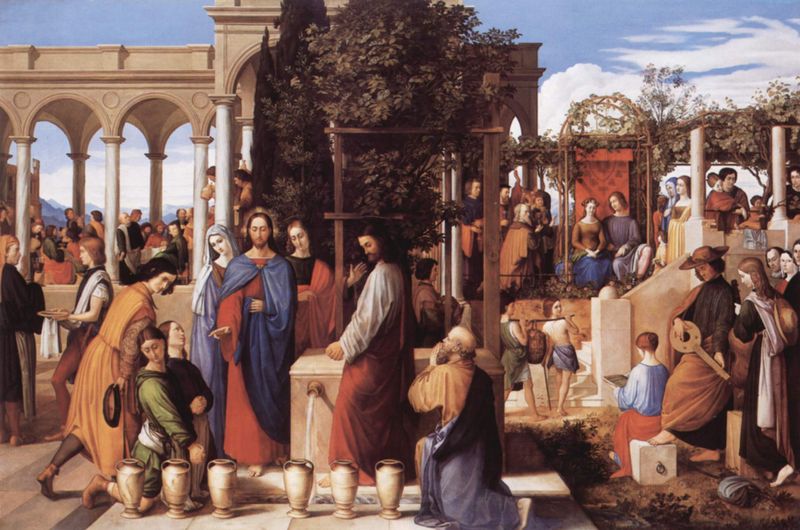
The Prayer at the Wedding


““. . . the mother of Jesus said to Him, ‘They have no wine’.”
(John 2:3)

We inevitably remember the Wedding Feast at Cana as the story of Jesus’ first miracle.
John normally used the word “sign” to designate Jesus’ mighty acts, because he wished to emphasize the particular message clothed in the miracle. The water-to-wine miracle was Jesus’ first sign , but it was not the first display of His supernatural capacity in John’s gospel. He’d already displayed a miraculous knowledge of Nathaniel in chapter 1.
Jesus never indulged anything remotely like magic, and His miracles were never random or without a message. Every sign was like a little parable telling of His person, power and purpose. The episode at the wedding also carries a lesson about prayer, because the emergency was met by a miracle summoned by a prayer. The prayer was a marvel of succinctness hidden in the form of an observation. It was prayed by Mary who summed the situation up in four words:
“...they have no wine.”
We hear only an observation; Jesus, however, hears a request. How else are we to understand His answer in John 2:4: “Woman what am I to do with you, My time has not yet come”?
We will be helped in our understanding of the gospels if we remember that Jesus seldom responded to words alone; He responded rather to thoughts. Have you ever noticed how sometimes Jesus appears to utter a non sequitur—i.e., an answer apparently unrelated to the question or a comment apparently out of place in the context? We see this again later in chapter two when the authorities in Jerusalem challenge His right to cleanse the Temple. Jesus’ response to them was a little mysterious: “Destroy this Temple and in three days I will raise it up” (John 2:19). But He was responding to their thoughts, as they were already thinking that He must die for opposing them.
We frequently use our words to throw a cloak over our true thoughts, but Jesus cuts through the artifice to address the real issue. Back to the wedding passage: if it were anyone else but the Lord, we would be tempted to think Mary was being treated with undue abruptness. After all, she was simply making an observation—or so it seemed on the surface. But the Lord is never interested in the surface. When He speaks to us, deep calls to deep. His response to Mary signals that what His mother may have wanted was some sort of disclosure of His full identity and office. The moment may have seemed propitious to her. But that the moment was premature is evident from His answer: “My time has not yet come.” When she speaks we can only hear an observation, but we can be sure that He heard a request. Characteristically she responds to His apparent rebuff with faith: she alerts the servants to be ready to obey His every command.
While we only hear a “no” in Jesus’ answer, Mary hears a “yes.” This is obvious from her response. She actually gives the servants the best counsel ever given in the history of the world: “Whatever He says to you: DO IT!” (John 2:5).
Perhaps Jesus did not do everything her heart could wish for. But He did something. And He met the need of the hour.
Now here is a remarkable thing and a lesson for every believer. What is our response when we believe God is telling us “no”? What do we do when we suspect He may not give us exactly what we want? The lesson from Mary, as relayed through her instructions to the servants, was simply this: if we think God is saying “no” to us we must be sure we are still saying say “yes” to Him. If we are disappointed, it is all the more urgent to insure that He is not disappointed.
Can we truthfully say that it is more important that we do what the Lord wants us to do than He do for us what we want Him to do? It’s no use pretending: our prayer life will only sustain one great burden. And while it’s certainly permitted to pray for God to act on our behalf, it’s a bad symptom if that one theme dominates our entire agenda.
Let us be confident that even if we can’t be sure He will give us what we want, He will do something. And that something will be a good thing and a better thing (though we may not see it) than what we asked. Let the burden of our prayer life be a determination to do what the Lord wants.
When we reach that place in prayer, we will witness the power of God. Indeed if we reach that place, we will have already witnessed it. The supply will be filled. The celebration will continue.
Just as it did at Cana.